
Padel tennis is taking the global sports and leisure industry by storm, cementing its position as the fastest-growing racket sport for commercial clubs, luxury resorts, multi-sport facilities, and high-end private properties worldwide. But for facility owners and investors, a high-performing, FIP-compliant padel court is never just a sum of off-the-shelf parts. Cut-rate components, rushed installation and misaligned construction lead to costly rework, inconsistent playability, safety risks and shortened service life — eroding your return on investment before your court even opens. At LDK we engineer and deliver complete padel court systems built for precision, durability and commercial success, backed by a field-proven step-by-step installation process that eliminates guesswork and delivers consistent, tournament-grade results every time.
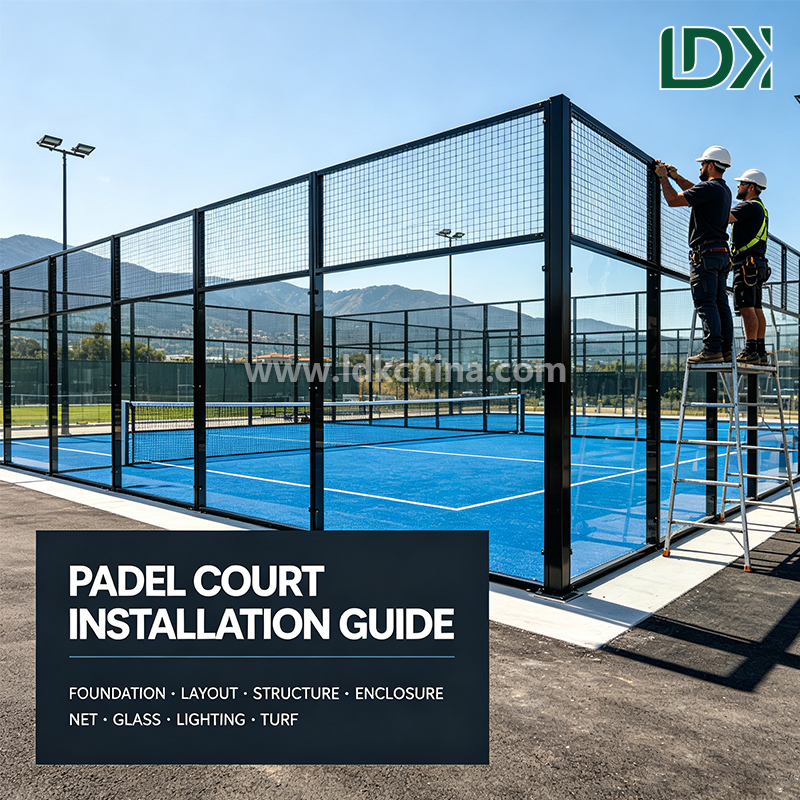
Why Invest in a Padel Tennis Court?
Before diving into the installation workflow, it’s worth understanding why padel courts deliver such strong value for facility owners:
• Unmatched player accessibility: Padel is easy to learn for all ages and skill levels,Suitable for people of all ages and skill levels, therefore participation and repeat booking rates are higher than many traditional racket sports.
• Space-efficient footprint: A regulation doubles padel court measures just 20m x 10m internally — roughly one-third the size of a full tennis court — making it ideal for sites with limited space.
• Low long-term maintenance: Built with galvanized steel frames, tempered glass, and durable artificial turf, padel courts require minimal upkeep and withstand heavy outdoor and indoor use.
• Strong revenue potential: For commercial clubs and resorts, padel courts deliver high hourly utilization rates, membership uptake, and ancillary sales opportunities.
• Flexible deployment: Available in permanent, panoramic, and modular mobile designs, padel courts can be tailored to indoor, outdoor, temporary, or permanent locations.
Padel Court Installation Process Step by Step
A properly installed padel court follows a clear sequence: starting with structural foundation work and moving toward delicate finishing components. This order protects fragile materials and ensures alignment accuracy at every stage.
Step 1: Pre-Installation Foundation Inspection
The foundation is the single most critical element of your padel court. Every steel column, glass panel, and turf seam depends on a level, dimensionally accurate base.
Before unpacking any court components, installers must verify:
• Overall court dimensions and slab flatness
• Concrete condition and structural integrity
• Drainage performance
• Anchor fixing zones and electrical connection points
• Surrounding clearance for installation equipment
Step 2: Site Setting Out & Layout Marking
Once the foundation passes inspection, installers transfer approved construction drawings onto the slab to mark exact positions for court corners, centerlines, structural columns, glass panel locations, door openings, net post positions and lighting placements.
Crucially, all measurements are taken from the internal finished dimensions of the court, not the outer edge of steel components. Installers also cross-check diagonal measurements to confirm the layout is perfectly square before drilling any anchor holes. This single step prevents one of the most common installation errors: misaligned panels on the final side of the court.
Step 3: Steel Structural Frame Assembly
The structural steel frame forms the backbone of the court. Installation crews:
1. Position and secure base plates at marked anchor points
2. Erect vertical columns and brace them temporarily
3. Install upper horizontal beams and structural bracing
4. Check plumb, level, and square alignment across the entire frame
5. Tighten all fasteners to specification
Connections are not fully locked immediately — progressive adjustment ensures the frame remains true as it comes together. This is especially critical for panoramic padel courts, where minimal structural steel means precise alignment is essential for glass fitting. Any scratches or coating damage to the steel are also addressed at this stage to preserve corrosion protection.
Step 4: Mesh Fencing Installation
The metal mesh enclosure is more than a barrier — it is a playable surface that influences ball bounce and player safety. Per FIP regulations, fencing must form flat, vertical surfaces with no sharp or protruding edges, reaching a total height of 4 meters at the court ends.
During installation, technicians verify panel alignment, mesh orientation, secure connection points, smooth transitions between mesh and glass sections, and proper fit around door openings. Panels are never forced into place; if a mesh section requires excessive force to align, the structural frame is rechecked before proceeding.
Step 5: Tempered Glass Panel Fitting
Glass installation demands the highest level of care, as panels are large, heavy, and vulnerable to edge damage. Each panel is positioned per drawing, supported correctly, and secured with specified fittings and protective spacers.
Installers pay close attention to vertical alignment, consistent gaps between panels, rubber spacer placement, correct fixing torque, and smooth transitions between glass and mesh. Beyond structural security, glass walls must create a consistent playing surface — a poorly aligned panel, even if safely secured, will cause unpredictable ball behavior.
Step 6: Lighting & Electrical System Setup
Lighting is installed once the main structure is stable, to avoid damage during heavy construction work. Depending on the court design, light poles may be integrated into the frame or mounted independently outside the enclosure.
The process includes mounting poles and LED fixtures, routing and securing electrical cabling, connecting control systems and safety devices, and adjusting fixture angles to eliminate glare. Per FIP rules, artificial lighting must be uniform across the playing surface and not create visual discomfort for players, officials, or spectators. For commercial facilities, a night-time test is recommended to fine-tune illumination.
Step 7: Artificial Turf Laying
Artificial turf is installed after all heavy structural, glass, and electrical work is complete. This protects the finished playing surface from damage by lifts, equipment, and construction traffic.
Before laying turf, the base must be clean, dry, level, and free of debris. Installers then unroll and position turf rolls with consistent pile direction, cut material to fit precisely around columns and perimeter edges, join seams securely for a flat surface. A properly laid turf surface has no visible ridges, wrinkles, or raised seams — all of which can affect player movement and ball rebound.
Step 8: Net, Doors & Accessory Installation
With the playing surface complete, installers fit the remaining court components: net posts and regulation padel net, access doors and handles, protective padding, branding panels, equipment covers, and bench seating.
The net requires special attention: Installers verify both height and tension, and ensure no protruding hardware creates a safety hazard for players.
Step 9: Final Alignment & Safety Inspection
A padel court is not ready for use when the last bolt is tightened. A comprehensive final inspection covers four key areas:
1. Structural check: Anchor connections, frame alignment, fastener tightness, mesh and glass fittings
2. Surface check: Turf seams, perimeter finish, infill distribution, level consistency, and drainage
3. Functional check: Lighting operation, door function, net tension, and electrical controls
4. Safety check: No sharp edges, loose panels, protruding fasteners, or trip hazards
How to Choose the Right Padel Court Supplier
The installation process is only as reliable as the manufacturer behind the court system. When selecting a padel court supplier, prioritize these factors to ensure a smooth build and long-term performance:
1. FIP-Compliant Engineering & Precision Manufacturing
Look for a supplier that builds courts to official FIP homologation standards, with precise engineering drawings that match foundation specifications. This is especially critical for overseas projects, where local civil work and factory-produced components must align perfectly.
2. Full Customization Flexibility
Every site is different. A trusted manufacturer offers customization options including frame colors, turf colors, lighting designs, branding integration, and both panoramic and traditional court styles — so your court fits your brand and space exactly.
3. End-to-End Project Support
The best suppliers don’t just ship parts — they support your project from initial design review and quotation through production, quality inspection, delivery, and after-sales technical support. This end-to-end approach reduces miscommunication and keeps your project on schedule.
4. Modular & Permanent Court Options
Whether you need a permanent fixed court or a modular mobile system that can be dismantled and relocated, choose a supplier that offers both. Modular courts are ideal for temporary venues, pop-up facilities, or sites where future relocation is planned.
5. Proven Track Record in International Projects
For buyers outside the manufacturer’s home country, experience with overseas installations is invaluable. A supplier with global project experience understands logistics, local construction coordination, and how to deliver clear technical support remotely.
FAQ
What is the correct order for padel court installation?
The standard sequence is: foundation inspection → layout marking → steel frame assembly → mesh fencing → tempered glass → lighting & electrical → artificial turf → net and accessories → final inspection. The exact order may vary slightly by court design.
Can a padel court be installed on an existing concrete slab?
Yes, but only after a thorough inspection. The slab must meet requirements for dimensions, levelness, structural capacity, drainage, and anchor fixing. An existing slab should never be assumed suitable just because it is large enough.
Should artificial turf be installed before or after the glass?
Turf is almost always installed after heavy structural work, glass fitting, and electrical work are complete. This protects the playing surface from damage by construction equipment and materials.
How long does padel court installation take?
Once the foundation is fully prepared and all components are on site, an experienced crew can install a standard court relatively quickly. However, total timeline varies widely based on court type, number of courts, crew size, weather, and site conditions. Foundation work, permitting, and shipping typically take much longer than on-site assembly.
Do I need a final inspection after installation?
Yes. Structural fixings, glass, fencing, turf, net, lighting, access points, and potential safety hazards should all be checked before the court is put into normal use.
A successful padel court installation comes down to three things: a properly prepared foundation, a disciplined step-by-step assembly process, and a reliable manufacturer that stands behind its product.
At LDK, we deliver FIP-compliant padel court systems with full customization, end-to-end project support, and proven performance for clubs, resorts, and commercial facilities worldwide. Our team provides detailed foundation drawings, installation guidance, and after-sales support to make your project smooth from start to finish.
Get in touch today for a free project consultation, custom quotation, and design guidance tailored to your site and budget.
Publisher:
Post time: Sep-15-2026


