
The 2026 padel competition calendar has already made one thing abundantly clear: as the sport scales from regional hobby to mainstream professional competition, weather reliability has become the single biggest differentiator between a profitable venue and an underperforming asset. From the Cupra FIP Tour Shanghai Gold event in June to the CPT-500 national tour stops across the country, this season’s schedule has run head-first into a growing pattern of extreme weather — sudden summer downpours, 40°C+ heatwaves and unpredictable crosswinds that force last-minute delays, rescheduled finals and lost sponsorship value at open-air facilities.
The same pattern holds true across other racket sports: 2026 China Squash Tour stops have consistently drawn the largest sponsorship and spectator numbers at fully enclosed, climate-stable venues, where organizers can guarantee broadcast schedules, corporate hospitality and uninterrupted play. For investors, the lesson is universal: a court’s revenue ceiling is no longer set just by its size or surface quality — it is set by how reliably it can be used, 365 days a year.
Industry benchmarks confirm what tournament organizers already know from experience: uncovered outdoor padel courts lose 30% to 45% of their annual bookable hours to rain, extreme heat and seasonal disruption, and many facilities see revenue drop by half during wet or winter months. A purpose-built tournament-grade roof recovers nearly all of that lost time, unlocks premium pricing and tournament hosting revenue, and typically lifts per-court annual revenue by 35% or more for premium operators.
Building a high-return padel facility starts with strict adherence to official FIP dimensional standards, and scales with a weatherproof roof engineered for both competitive compliance and long-term asset protection. In this guide, we break down the official court sizing rules every investable venue must follow, walk through the full business case for covered tournament courts, and introduce the LDK fixed padel court roof — a typhoon-rated, tournament-proven solution deployed across 70+ countries, and the same system that has kept national-level events running on schedule through extreme weather this season.
Official FIP Padel Court Dimensions: The Foundation of an Investable Asset
Dimensional compliance is not just a regulatory checkbox — it is the baseline for tournament eligibility, premium pricing and long-term asset value. Courts built off-standard cannot qualify for FIP-sanctioned events, cannot charge premium rates to competitive players, and consistently underperform on the secondary market. For investors, building to exact FIP specifications is how you protect your downside and unlock the highest possible revenue ceiling.
Core playing area measurements
Every FIP-approved padel court uses the same rectangular enclosed footprint to ensure consistent gameplay anywhere in the world:
· 20 meters internal length, 10 meters internal width
· ±0.5% maximum tolerance on all primary dimensions
· Net height: 88 cm at the center, 92 cm at the side posts
· Service lines marked 6.95 meters back from the net on each side, split by a central service line
· 5-centimeter-wide court lines, in high contrast to the playing surface
Glass walls and metal mesh enclosures mount flush to these internal measurements, with no protrusions into the play zone that could create safety risks or alter ball bounce.
Total site footprint: plan for full value
The 20×10 meter play area is only the inner zone. A complete court with structural columns, safety margins and drainage needs a larger site envelope:
· Standard external footprint for one full court: 22 meters long by 12 meters wide
· Recommended setback from property lines: 1.5 to 2 meters on all sides for maintenance access
· Spectator walkways and seating: add 2 to 3 meters per side for commercial event venues
This 22×12 meter envelope is also the standard sizing for professional padel court roof systems, giving full coverage of the court structure plus enough overhang to shield side walls and walkways from rain and sun.
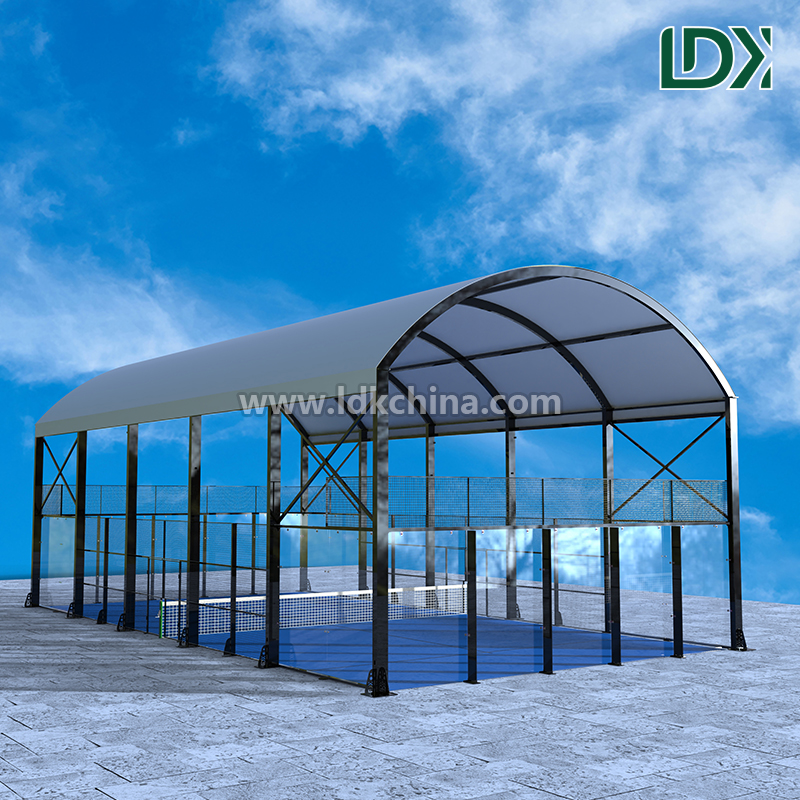
Professional Weatherproof Steel Structure Padel Court Roof for Outdoor Sports Clubs
The Business Case for Covered Courts: Where Your ROI Actually Comes From
A fixed padel roof is not a cosmetic upgrade — it is a revenue and operational multiplier that touches every line of your P&L. Here’s how it moves the numbers for real club operators.
1. Recover lost booking hours and lock in predictable revenue
Rain is the single biggest revenue killer for outdoor padel. Even light rain makes artificial turf slippery and saturates balls, forcing play to stop immediately per competition rules. Full drying can take two to four hours — often wiping out an entire evening’s worth of peak-time bookings.
Properly engineered fixed roof eliminates nearly of rain-related downtime. For a typical club charging €50 to €80 per peak hour, recovering 30% to 45% more bookable hours per year translates to €25,000 to €45,000 in incremental revenue per court, annually. That consistency also makes staff scheduling, inventory planning and membership forecasting far more reliable, reducing operational waste.
2. Charge premium rates and unlock high-margin revenue streams
Covered tournament-grade courts support materially higher pricing and open up revenue lines that open-air venues can never touch:
· 20% to 30% higher hourly rates for guaranteed all-weather court time
· Corporate and private event packages that clients will book months in advance, because they don’t risk a rainout
· Elite coaching camps and academy programs that require consistent conditions
· Tournament hosting revenue, including venue rental fees, sponsorship activations and spectator ticketing
Top-performing European clubs consistently report that covered courts generate 50% to 70% more revenue per square meter than equivalent uncovered courts. For venues that land official FIP or national tour events, the branding and ancillary revenue from a single tournament can cover a large share of the initial roof investment.
3. Lower long-term maintenance and extend your asset’s life
UV exposure, constant moisture and freeze-thaw cycles wear down turf, glass seals, metal hardware and court markings much faster. A roof acts as a protective shield, cutting down on:
· Artificial turf fading and compaction
· Corrosion on metal enclosure parts
· Mold and moisture damage to the court sub-base
· Frequent surface cleaning and line repainting
Facilities with professional roof systems typically see a 20% to 30% drop in annual court maintenance costs, and add 3 to 5 years of usable life to their playing surface — reducing future capital expenditure significantly.
4. Build brand equity that keeps members and sponsors coming back
Venues that can host certified tournaments gain a brand advantage no amount of social media marketing can buy. Official FIP events bring media coverage, livestream audiences and regional industry exposure that elevates your club’s reputation overnight.
Roofed tournament venues also deliver a more consistent, premium player experience, which drives higher member retention, stronger word-of-mouth referrals and lower customer acquisition costs over time.
The LDK Fixed Padel Court Roof: Built to Protect Your Investment
With 45 years focused exclusively on sports facility manufacturing, LDK is China’s leading professional supplier of padel courts, pickleball courts, squash courts, basketball halls and cage football systems, with installations in more than 70 countries and regions.
Our fixed padel court roof was designed specifically for tournament venues and premium clubs operating in high-wind, high-rainfall and extreme climate zones. Engineered to typhoon-level structural standards and sized to exceed FIP competition clearance requirements, it’s built for commercial-grade durability, predictable maintenance costs and fast time-to-revenue — all engineered around maximizing your long-term return.
Heavy-duty steel frame: 20+ years of structural life
The entire support structure is made from high-grade hot-dip galvanized steel for maximum corrosion resistance and rigidity:
· Main load-bearing columns: 150×200×4mm rectangular steel tube
· Primary arch beams: Φ102×3mm and Φ89×3mm round steel tube
· Secondary bracing and purlins: Φ40×3mm round steel tube
· All joints connected with high-strength bolts — no on-site welding required, which speeds up installation and ensures consistent structural integrity
Every steel component gets a full electrostatic powder coating finish after galvanizing. This dual-layer protection creates a smooth, tough exterior that meets GB15065-94 and IE60502 quality standards, with 0% water absorption for long-term corrosion resistance and a design life of 20+ years.
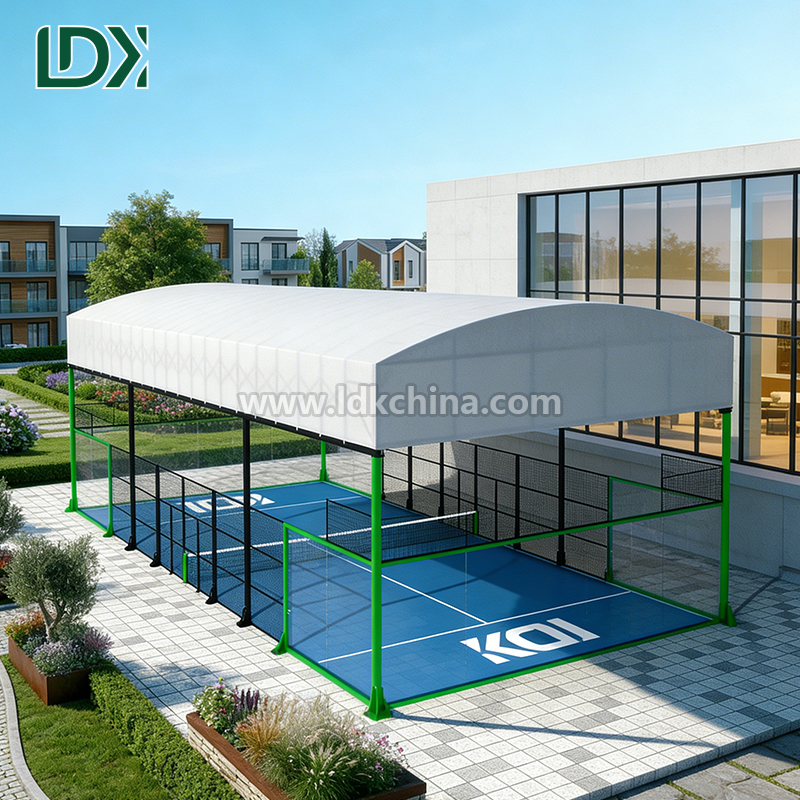
Typhoon-rated wind resistance: protect your asset from extreme weather
Unlike lightweight recreational canopies, the LDK padel roof system is engineered and rated to withstand level 10 to 13 typhoon conditions.
This level of performance comes from triangulated bracing that distributes lateral loads, rigid bolted connections with zero structural play, and a taut membrane tensioning system that eliminates wind flutter and fatigue. For coastal venues, typhoon-prone regions and high-wind zones, this engineering protects your capital investment from catastrophic weather damage and reduces long-term insurance and repair costs.
Premium PVDF roof membrane: 10–15 years of low-maintenance service
The roof covering is made from high-strength PVDF architectural membrane with a reinforced PVC surface coating — the industry gold standard for outdoor sports canopies:
· Excellent UV resistance and solar reflectivity, which lowers court surface temperature in direct sun
· A self-cleaning surface — rain washes away dust and debris, cutting down on scheduled maintenance
· High tear and puncture resistance, with strong tensile strength for high-wind environments
· Rated service life of 10 to 15 years under normal climate conditions, with only basic annual inspections needed
The arched membrane shape is hydrodynamically designed for natural rain runoff, preventing ponding and reducing snow load buildup in colder climates. The membrane can also be replaced independently at end of life without modifying the existing steel frame, lowering future capital costs.
Reference for system dimensions:
| Parameter | Measurement |
| Total covered footprint | 22m (L) × 12m (W) |
| Eaves height | 7 meters |
| Ridge height | 9.2 meters |
| Wind resistance rating | Level 10–13 typhoon |
| Membrane material | PVDF with PVC surface coating |
| Frame material | Hot-dip galvanized steel + powder coating |
Proven Results: Real-World Performance Across Europe & China
LDK padel solutions are deployed in the world’s most mature padel markets, with a track record of delivering measurable revenue and operational improvements for club owners and investors.
LDK Padel Court with Roof Solutions
To meet global demand, LDK has developed complete padel court with roof solutions, applied in various international projects including Spain and France.
Spain Project-Commercial Club Installation
multi-court layout design
tensile membrane roof system
panoramic padel court configuration
Project Results:
increased court usage
reduced weather-related downtime
improved operational efficiency
France Project-Premium Facility Upgrade
polycarbonate roof system
integrated lighting solution
enhanced player experience design
Project Results:
stronger market positioning
higher member retention
improved training conditions
Frequently Asked Questions
FIP tournament certified?
Yes. Open-sided covered courts qualify for FIP certification.
How is wind resistance verified?
Level 10–13 typhoon rating.
Compatible with lighting & drainage?
Yes. Pre-drilled mounting points for LED lighting, audio and cameras.
Custom multi-court layouts?
Yes. Full custom engineering for single courts, connected rows and clubhouse-integrated complexes, with adjustable span, height and snow load rating.
Publisher:
Post time: Jul-20-2026


