[International Sports Infrastructure Weekly – May 2026] As the 2026 North American World Cup approaches—and amidst an unprecedented global rise in awareness regarding the health and safety of professional athletes—the field of sports venue construction is undergoing a transformative shift: moving from an era focused solely on “hard infrastructure” to one defined by “scientific protection.” In high-intensity, high-contact indoor sports involving rackets and balls—such as basketball and badminton—flooring systems are no longer viewed merely as the playing surface; rather, they are now regarded as the primary “shock-absorbing line of defense” for safeguarding an athlete’s professional career.
This article delves into the core of the modern “smart sports venue”: the integration logic behind professional-grade basketball shock-absorbing systems and premium maple flooring. It explores how high-tech engineering—through breakthroughs in physical structural design—works to minimize injuries to athletes’ knees and ankles.
I. Maple Flooring: The Gold Standard in Western Professional Sports
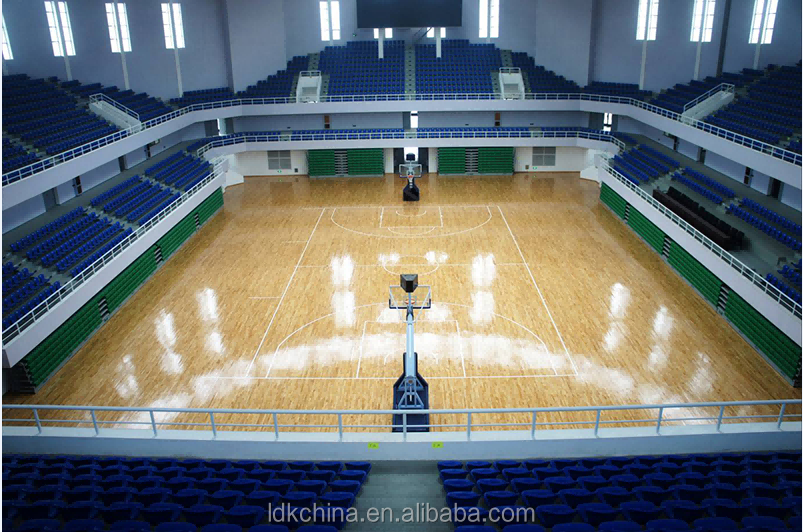
In the Western B2B market for sports facility procurement, when the subject of professional basketball courts arises, maple flooring stands as the sole surface material holding a near-monopolistic position. However, for seasoned contractors and venue operators, the true value of maple flooring extends far beyond its bright coloration and minimalist aesthetic appeal.
- Exceptional Physical Properties and Fiber Structure: Hard Maple—which grows in cold climatic zones—possesses a long growth cycle, resulting in wood fibers of extremely high and uniform density. This endows the flooring with exceptional impact resistance and durability. During professional competitions, players’ sudden stops and directional changes generate immense friction and shear forces; maple’s compact grain structure ensures that the flooring remains free of cracks or dents even under prolonged, high-intensity use, thereby mitigating the risk of tripping caused by uneven surfaces.
- Stable Coefficient of Friction: Professional venues in the West impose extremely stringent requirements on the anti-slip finishes applied to flooring surfaces. Top-tier maple flooring, when paired with specialized sports-grade coatings, delivers a stable coefficient of friction ranging between 0.4 and 0.6. This parameter is critical: a surface that is too slippery leads to falls, while one that is too abrasive can cause sprains or contusions to players’ ankles during sudden stops.
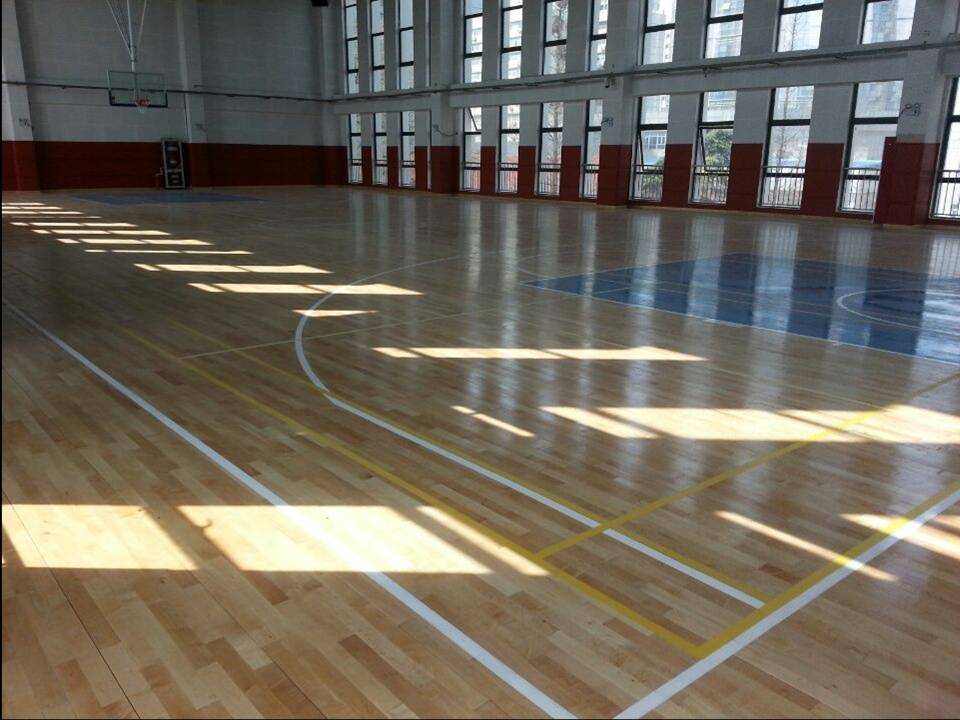
Sports Flooring Basketball Court Glossy Hard Maple Wooden Floor FIBA Fixed Floating
II. Shock-Absorbing System: The Invisible “Biomechanical Shield”
If maple flooring serves as the “skin” of the court, then the shock-absorbing system concealed beneath it acts as the venue’s “bones and muscles.” In the B2B sector, the true measure of a manufacturer’s professionalism lies not in the type of wood they sell, but rather in the ingenuity of their underlying shock-absorbing structural design.
- Technical Standards for Shock Absorption: According to the international DIN 18032-2 standard, a professional basketball court system must achieve a shock absorption rate of ≥53%. This mandates that when a player jumps and lands, more than half of the resulting impact force must be absorbed by the flooring system rather than being transmitted back into the player’s bones and joints. Through a breakthrough in materials science involving multi-layered resilient pads, the 2026 high-tech shock absorption system has successfully achieved the differentiated filtration of both minute vibrations and high-energy impacts.
- Regarding the balanced shock-absorption systems used to manage vertical deformation, a softer surface is not necessarily superior. If the flooring is excessively soft—resulting in excessive vertical deformation—athletes may experience a sensation akin to “sinking into mud” while running, a condition that significantly increases the risk of stress fractures. Modern smart sports courts address this issue by employing a double-sleeper structure combined with precisely arranged L-Resilient rubber pads to regulate vertical deformation within a scientifically established optimal range of 2.3 mm to 3.5 mm; this approach effectively safeguards athletes’ joints while simultaneously ensuring ample energy return.
III. Structural Integration: How does the five-layer process construct a safety barrier?
A Basketball Wooden Flooring system designed for high-end markets in Europe and North America, such as collegiate team gymnasiums and professional clubs, generally comprises the following five core layers in its manufacturing process:
- High-wear-resistant anti-slip top coat: Environmentally compliant UV-cured water-based paint dedicated for sports venues is adopted, whose Taber Abrasion resistance is far superior to that of ordinary civilian paint.
- Hard maple panel layer: High-quality hard maple harvested at latitudes above 30 degrees north is utilized, which undergoes precision grooving and moisture content equilibrium treatment.
- Plywood Subfloor (Pressure Distribution Layer): Two layers of interlaced 12mm plywood are employed to disperse the pressure from players’ footfalls.
- LVL Sleeper (Structural Joist): Durable laminated veneer lumber is applied to ensure that the system does not generate abnormal noise under high-frequency use.
- Shock Pads (Core Elastic Component): High-damping synthetic rubber is utilized, which can maintain its initial resilience even after ten years of service, and this is the key to preventing long-term chronic injuries in athletes.
IV. 2026 Market Outlook: How B2B Procurement Can Avoid the “Low-End Trap”
Within the globalized supply chain, B2B procurement managers in Europe and North America are gradually phasing out low-end suppliers—those who merely sell “wooden planks.” In anticipation of sports infrastructure demands in 2026, a manufacturer’s true competitiveness will be defined by its integrated solution capabilities.”
- Resolutely Avoid Single-Layer Structures:Low-end, fixed flooring systems are being rapidly phased out in Western markets, as their exceptionally high injury rates place immense pressure on insurance payouts.
- Prioritize Environmental Adaptability:New flooring systems emerging in 2026 incorporate environmental monitoring chips capable of real-time humidity tracking within the venue and automated maintenance alerts—a feature critical to maintaining the flooring’s shock-absorbing stability.
- Sustainability and ESG:Major clients in Europe and North America are paying increasing attention to FSC certification for timber and the recyclability of shock-absorbing materials.
V. Conclusion: Investing in the Health of Every Player
From the perspective of materials science, Maple Flooring and Shock-Absorbing Systems are mutually complementary. Without the durability and aesthetic appeal of maple, a venue lacks a professional quality; yet, without the support of a high-tech shock-absorbing system, that maple flooring becomes a silent threat to an athlete’s health.
Amidst the 2026 trend toward “smart stadium” construction, investing in professional systems with high shock-absorption rates represents more than just a hardware upgrade for the venue; it is a long-term investment in the professional longevity of athletes and the brand reputation of the venue operator. As a leading global supplier of basketball wooden flooring, we are dedicated to refining every millimeter of our craftsmanship to ensure that the sports arena becomes a true sanctuary of safety.
Publisher:
Post time: May-13-2026